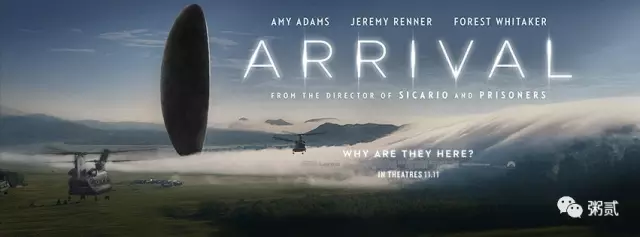
The rotten tomatoes 93-scored Arrival, adapted from Ted Chiang's The Story of Your Life, is quite puzzling as to why it added so many Hollywood-style international politics and Chinese elements. Moreover, those few lines of Chinese were completely unintelligible... (Isn't it supposed to be the US that's trigger-happy? Why did it become China taking the lead with Russia following suit?)
Near the end, the female lead's phone call to a PLA general as a plot twist seems a bit abrupt. The first half of the movie has a slow pace that's confusing to watch. The process of understanding the alien language through contact also fails to convey the relationship between language and thought patterns as described in the novel. However, the scenes depicting the female lead's memories are beautifully shot, with comfortable editing and music that inexplicably evoke a tearful feeling.
In fact, if we detach from the plot, the movie is not trying to tell a story, but rather to explore a different way of thinking. Human thought patterns, language, and words all follow the principle of cause and effect, where event A occurs before event B, and thus human language is composed of words in a sequential order.
The thought pattern brought by the Heptapods is completely the opposite. For event B to occur, event A must happen. In other words, they know what they want to say before they write this sentence, and they can predict the future.
However, this raises the question: if the future is not what you imagine, will you make changes? Naturally, people will choose to avoid harm and change towards a more favorable direction. But as Chiang points out in the novel: "The existence of free will means that we cannot predict the future.
"If we can predict the future, it means that we have lost our free will and no longer have the possibility of choice. It's because we can choose freely that I won't resist this predetermined fate, nor can I tell others about the future I know - this is also a form of resistance. Those who can predict the future won't talk about it, and those who have read the book of years won't admit to having read it."
It's like actors on a stage, who have already memorized their lines and those of their counterparts before the play begins. They already know the ending, but they still have to follow the script and move step by step towards the predetermined future.
"I knew the ending from the beginning, and I chose my path accordingly. But am I working towards a maximum of joy or a maximum of pain? Will I achieve a minimum or a maximum?"
So, thinking about it this way, I feel that perhaps it's still better to have free will and be ignorant of the future. Humans have only two points in life - birth and death - but because of the existence of free will, we have countless choices and can create countless wonderful lives.
I really like the ending of the novel:
From the beginning I knew my destination,
And I chose my route accordingly.
But am I working toward an extreme of joy,
Or of pain?
Will I achieve a minimum,
Or a maximum?
These questions are in my mind
When your father asks me,
“Do you want to make a baby?”
And I smile and answer,
“Yes,”
And I unwrap his arms
From around me,
And we hold hands
As we walk inside
To make love,
To make you.
-END-
Bonnuit.
若无法加载请检查网络环境。
若无法加载请检查网络环境,或切回 Disqus 稍后再试。