LAG vs LACP: Understanding the Difference
In the realm of Ethernet switch connections, link aggregation is a technology that combines multiple ports in parallel between different network switches. Its function is to economically and efficiently expand bandwidth and provide redundancy in the event of link failures. However, the overarching term "link aggregation" is quite broad, encompassing various concepts: Link Aggregation Control Protocol, Link Aggregation Group, MLAG, 802.3ad, 802.1AX, etc. The issue of LAG and LACP has caused confusion for many. Here, we introduce LAG and LACP in sequence and compare LAG and LACP to illustrate their relationship and differences.
LAG vs LACP: What is LAG?
LAG (Link Aggregation Group) is the actual technology or instance of link aggregation. When we connect multiple ports in parallel between two switches and configure them as a LAG, a link aggregation group is formed. Therefore, LAG establishes multiple links between two switches, thus expanding bandwidth. Additionally, it provides link-level redundancy in network failures and load-balances traffic. Even if one link fails, the remaining links between the two switches will still run. They will also take over the traffic that was supposed to traverse the failed link, so packets will not be lost.
LAG vs LACP: What is LACP?
LACP (Link Aggregation Control Protocol) is a control protocol that automatically sets up LAG. Therefore, you can choose to build a static LAG without LACP. Or, you can choose to set up a dynamic LAG using LACP. In short, LACP is not an instance of link aggregation, but a protocol used to define it. LACP enables LAG to transmit from static LAG to dynamic LAG, allowing the exchange of link aggregation information between network switch components. The information is transmitted in the form of packets in LACPDU (Link Aggregation Control Protocol Data Unit). Each port on the two switches can be configured as active or passive through the control protocol, so as to prioritize the transmission of LACPDU or not.
LAG Implementation Schemes
Since LACP is just a protocol of the link aggregation group, we will omit the differences between LAG and LACP to look at LAG implementation schemes according to FS.COM. For example, LAG between two gigabit PoE network switches and another 10GbE fiber switch. Just by connecting one port on each gigabit PoE switch with a cable, you can get 1GE bandwidth. However, when you dual-link, triple-link, or higher multiples, the bandwidth will become 2GE, 3GE, etc.
Furthermore, to connect to the upstream backbone core switch, we can use four fiber optic jumpers and corresponding modules to connect the 10GE SFP+ port of the 48-port gigabit PoE switch and the 10GbE fiber switch. Then, the upstream link bandwidth of the S1600-48T4S is expanded to 40GE. In this case, two LAGs are formed on the 48-port PoE switch. The upper limit of the number of links that form LAG and the number of LAGs between two switches vary depending on the vendor and switch model.
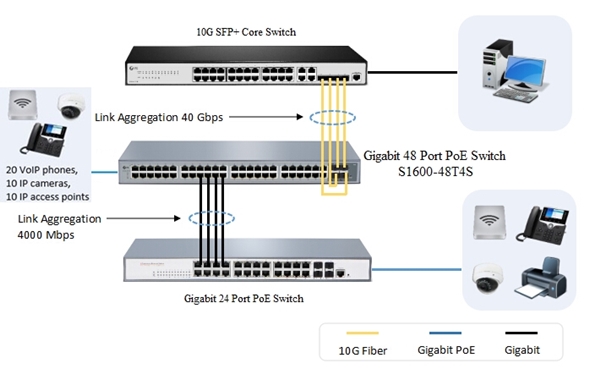
Figure 1: Four 1GE ports are connected in parallel on the FS 48-port PoE switch and 24-port PoE switch to set up LAG, thus increasing the bandwidth from 1000Mbps to 4 × 1000Mbps. In this photo, two LAGs are implemented on the FS 48-port PoE switch.
LAG and LACP: Link Aggregation Advantages, Scalable Bandwidth
Whether LAG deploys the Link Aggregation Control Protocol or not, it does not require expensive hardware upgrades. Therefore, the link aggregation group provides an economically efficient solution for bandwidth expansion. Stacking switches is indeed an advanced method to achieve higher bandwidth. However, it is limited to stackable switches and does not support separate placement. Buying a higher-speed switch like a 10GbE switch is also a direct and effective solution. But for ordinary users, such hardware upgrades are beyond budget.
LAG and LACP: What are the Differences?
A link aggregation group is an actual instance of link aggregation, while LACP is a protocol used for automatic configuration and maintenance of LAG.
A LAG without the Link Aggregation Control Protocol is a static configuration, where each pair of ports in the LAG needs to be manually configured separately. However, ports enabled with LACP are dynamically configured and can be automatically configured into a relay group when building LAG.
When talking about LAG and LACP, people usually refer to static LAG without LACP and dynamic LAG with LACP. Generally, dynamic LAG configuration has the advantage of automatic fault transfer and dynamic configuration compared to static LAG configuration. In static link aggregation, LAG cannot separate configuration or wiring errors, resulting in unnecessary network failures.
Conclusion
The issue of LAG and LACP is raised because of the confusing concepts between them. LAG is an actual instance of link aggregation. LACP is a control protocol used to enable LAG to automatically configure network switch ports, separate link faults, and activate fault transfer. Therefore, LAG includes static LAG configuration and dynamic LAG configuration, depending on whether the optional Link Aggregation Control Protocol is adopted. Overall, the link aggregation group is an economically efficient way to expand bandwidth through switch stacking and other hardware upgrade methods. To minimize network link failures, enabling LACP's dynamic LAG configuration on static LAG is a better solution.
Original article: https://www.fiber-optic-components.com/llag-vs-lacp-relationship-difference.html
若无法加载请检查网络环境。
若无法加载请检查网络环境,或切回 Disqus 稍后再试。